Adventures in Sound: A Peek into architecture TCP Server for the recorded .WAV Files

Hey everyone! You know that feeling when you’ve been working on a project that you’re really excited about? Well, I can’t wait to share mine with you!

I’ve been building a TCP Server that receives .WAV files from a client and saves them to a special spot. To make things even more interesting, I’m using a clean architecture – keeping everything nice and neat in their own separate layers.

The Grand Design

Let me take you on a tour of the architecture. Imagine a four-layer cake:

  1. Entities Layer: The heart of the cake (or application, in this case) is the FileEvent class.
  2. Use Cases Layer: The TCPService interface and its implementation, TCPServiceImpl, bring the action. They define and perform operations on our entities.
  3. Interface Adapters Layer: FileRepository and FileRepositoryImpl handle saving those .WAV files we’re receiving.
  4. Frameworks and Drivers Layer: Finally, at the top, we have TCPServer and ConfigManager. TCPServerlets us interact with the lower layers and ConfigManager keeps our settings in check.

Packaging Things Up

Inside this project, everything’s got its own home. I’ve got separate packages for different functionalities:

  • com.smartmachine.tcpserver houses TCPServer TCPServer, the heart of the application.
  • com.smartmachine.tcpserver.service is home to the service interfaces and their implementations.
  • com.smartmachine.tcpserver.repositorycontains repository interfaces and their implementations.
  • com.smartmachine.tcpserver.config keeps the configuration management classes.
  • com.smartmachine.tcpserver.model is where the entity classes chill.

Meet the MVPs

Shoutout to the key components of my project:

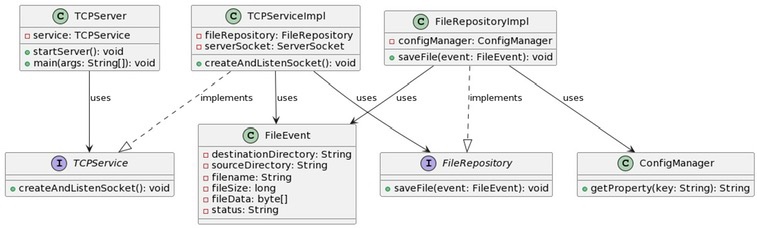
  • TCPServer: The entry point, it takes the help of TCPService to manage incoming client connections and file transfers.
  • TCPService and TCPServiceImpl: The guts of the business logic – processing .WAV files sent over TCP.
  • FileRepository and FileRepositoryImpl: The storage unit, they take care of storing the received .WAV files.
  • ConfigManager: The settings master, handling everything from server port to output directory.
  • FileEvent: Representing the data structure of the file event, including file data and metadata.

Keeping Things Running Smoothly

In any good adventure, you’ve got to plan for the unexpected. That’s why I’ve got basic error handling, ready for any hiccups like file not found, IO errors, and network errors.

Setting the Stage

And finally, all settings for the project are kept in a properties file. The trusty ConfigManager takes care of loading and accessing these settings.

UML Diagram
The Building Blocks of My AI Sound Recognition System: Unpacking the Server Architecture

The journey towards creating an innovative AI sound recognition system for washing machines begins with establishing a robust server that records sounds from a microphone. For this purpose, I procured two critical components: an ESP8266 and a Teensy 4.1.

The ESP8266, a low-cost Wi-Fi microchip with full TCP/IP stack, will be the heart of my sound recording setup, serving as a transmitter. After connecting and soldering it together with the Teensy 4.1, a powerful microcontroller board, the system will capture the sounds from the washing machine and transmit the data over a Wi-Fi connection.

This is where the Raspberry Pi comes in. Transforming this affordable, compact computer into a server will allow it to receive the sound data from the ESP8266 transmitter. I have planned to run a TCP server on the Raspberry Pi, a design that will ensure seamless communication and sound data transmission.

Currently, I’m developing the architecture for this TCP server, and I’m leaning towards the Clean Architecture model for numerous reasons:

  1. Separation of Concerns: By dividing the server’s functionalities into distinct layers, the complexity of the overall system is significantly reduced.
  2. Improved Testability: Isolation of each layer promotes efficient unit testing, leading to a reduction in bugs and higher quality code.
  3. Maintainability and Scalability: Thanks to the code decoupling, the system becomes easier to maintain, modify and scale, allowing for seamless addition of new features or changes.
  4. Independent Development: Separate layers can be worked on independently, boosting productivity in team-based projects.
  5. Framework Independence: The server’s business logic is not dependent on any specific framework, enabling easy technology switches without rewriting the core logic.

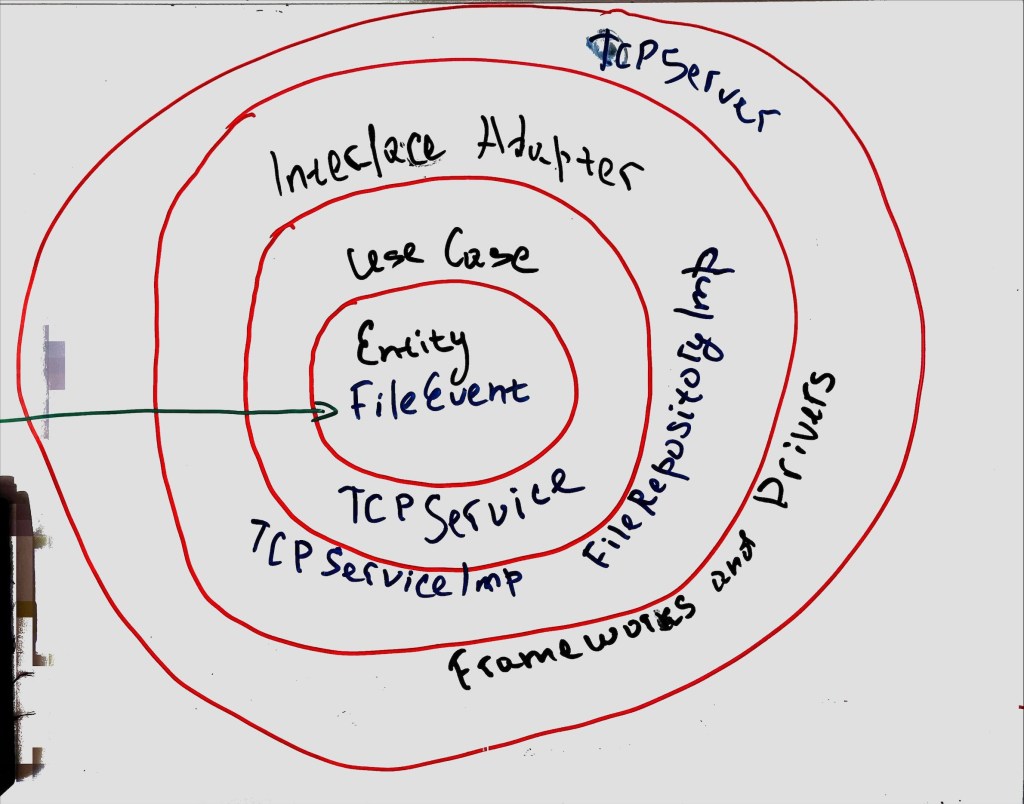
In essence, this is the blueprint for my server architecture. Though it’s in the preliminary stages, the sketch on the board outlines how the components interact (see attached image). This initial phase lays the groundwork for the innovative AI-powered sound recognition system, bringing us one step closer to smart laundry management.

Architecture for TCP Server

Central to this architecture is the Entity, represented in my design by FileEvent. Entities encapsulate the most critical business rules or the core logic of the system. In this case, FileEvent signifies the occurrence of a new sound file recorded by the microphone.

The next layer houses the Use Cases, which I’ve realized as the TCPService class. Use Cases encapsulate specific, user-driven software interactions, serving as the bridge between the business rules in the Entity layer and the external systems in the outer layers. The TCPService class manages the interactions between the microphone recording system and the server, ensuring the smooth transfer of sound files.

Following that, we have the Interface Adapters layer, which in my architecture is implemented as the TCPServiceImplementation and the FileRepositoryImplementation. Interface Adapters convert data between a format convenient for Entities and Use Cases, and a format suitable for things like the web, the database, the UI, etc. In my project, these classes handle the conversion of the sound data and the logging of the file events to a format that’s usable for the rest of the system.

The outermost layer of the architecture is Frameworks and Drivers, represented by the TCPServer in my system. This layer comprises tools like the database and the web framework. These are generally interchangeable without affecting the business rules. The TCPServer here manages the networking aspects of the system, like receiving and sending data over the Wi-Fi connection.

In conclusion, this layered architecture allows for better separation of concerns, independent development, increased testability, and framework independence. Each layer has its purpose, working together to create an efficient, robust, and scalable system that can recognize different sounds from a washing machine, analyze them, and notify the user. The promise of intelligent laundry management is becoming a reality, one layer at a time.

Revolutionizing Laundry with AI: Leveraging Sound Recognition for Smart Home Solutions

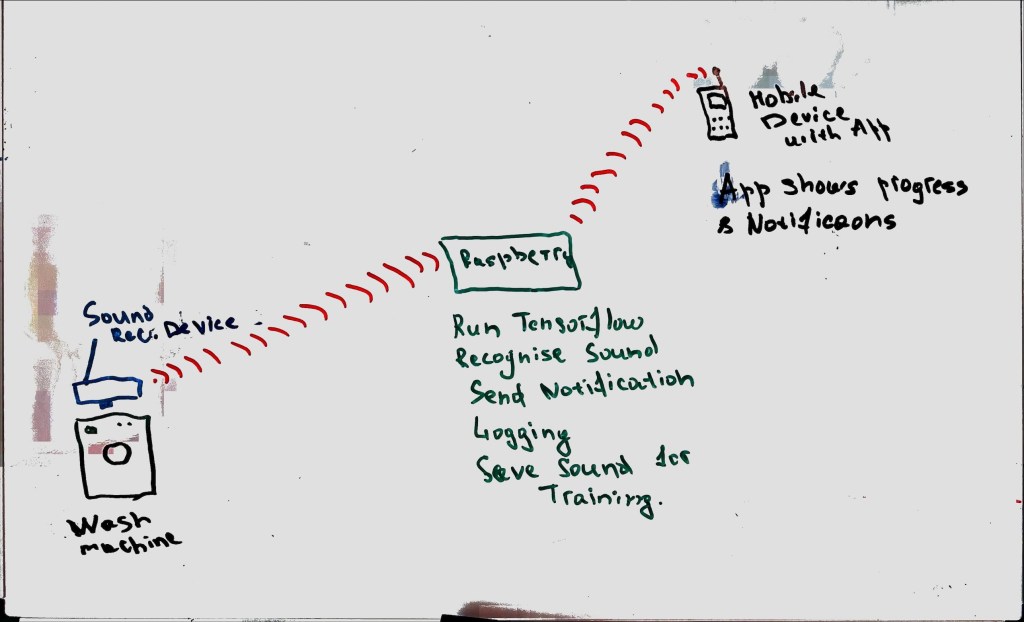
Every day, we embrace advancements in technology, integrating them into our daily lives to streamline tasks, improve efficiency, and ultimately make our lives easier. One such innovation in the pipeline is a smart system designed to interact with a common household appliance we all use – the washing machine.

The cornerstone of this system is a simple, yet intelligent device attached to the washing machine. The primary function of this device is to record sound, but what makes it unique is its ability to use these recordings in ways that redefine our interaction with appliances.

Recordings from the device are transmitted over Wi-Fi to a Raspberry Pi, a small and affordable computer used for numerous programming and DIY projects. The Raspberry Pi serves as a hub that uses the TensorFlow framework, an open-source software library for machine learning and artificial intelligence, to analyze the sound data.

Through TensorFlow’s capabilities, the system recognizes and categorizes the different types of sounds the washing machine produces. It can determine whether the machine is in the wash, rinse, spin, or end cycle, or if it’s idle, or even if it’s exhibiting any unusual noises indicating potential mechanical problems.

Once the sound is recognized and classified, the Raspberry Pi logs the information. But the intelligence of the system doesn’t stop there. A notification is then sent directly to the user’s mobile device, alerting them about the current status of the washing machine.

Simultaneously, the sound data is stored on the Raspberry Pi. This data is then used to train the TensorFlow models, allowing the system to learn from every cycle and continuously improve its sound recognition capabilities.

This innovative project highlights the transformative potential of integrating AI into our daily lives. The ability to train a model that recognizes various types of washing machine sounds and communicates with users in real-time brings a new level of intelligence to our homes. With such advancements, the future of smart home solutions looks promising.

System Overview