The journey towards creating an innovative AI sound recognition system for washing machines begins with establishing a robust server that records sounds from a microphone. For this purpose, I procured two critical components: an ESP8266 and a Teensy 4.1.
The ESP8266, a low-cost Wi-Fi microchip with full TCP/IP stack, will be the heart of my sound recording setup, serving as a transmitter. After connecting and soldering it together with the Teensy 4.1, a powerful microcontroller board, the system will capture the sounds from the washing machine and transmit the data over a Wi-Fi connection.
This is where the Raspberry Pi comes in. Transforming this affordable, compact computer into a server will allow it to receive the sound data from the ESP8266 transmitter. I have planned to run a TCP server on the Raspberry Pi, a design that will ensure seamless communication and sound data transmission.
Currently, I’m developing the architecture for this TCP server, and I’m leaning towards the Clean Architecture model for numerous reasons:
- Separation of Concerns: By dividing the server’s functionalities into distinct layers, the complexity of the overall system is significantly reduced.
- Improved Testability: Isolation of each layer promotes efficient unit testing, leading to a reduction in bugs and higher quality code.
- Maintainability and Scalability: Thanks to the code decoupling, the system becomes easier to maintain, modify and scale, allowing for seamless addition of new features or changes.
- Independent Development: Separate layers can be worked on independently, boosting productivity in team-based projects.
- Framework Independence: The server’s business logic is not dependent on any specific framework, enabling easy technology switches without rewriting the core logic.
In essence, this is the blueprint for my server architecture. Though it’s in the preliminary stages, the sketch on the board outlines how the components interact (see attached image). This initial phase lays the groundwork for the innovative AI-powered sound recognition system, bringing us one step closer to smart laundry management.
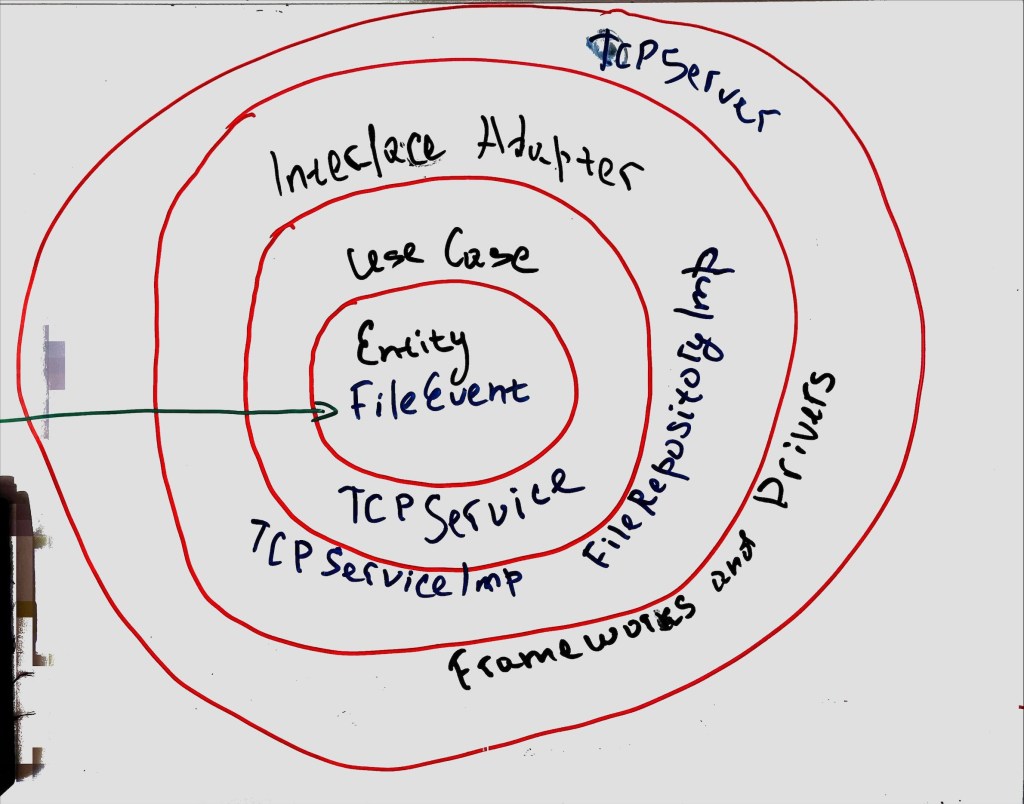
Central to this architecture is the Entity, represented in my design by FileEvent. Entities encapsulate the most critical business rules or the core logic of the system. In this case, FileEvent signifies the occurrence of a new sound file recorded by the microphone.
The next layer houses the Use Cases, which I’ve realized as the TCPService class. Use Cases encapsulate specific, user-driven software interactions, serving as the bridge between the business rules in the Entity layer and the external systems in the outer layers. The TCPService class manages the interactions between the microphone recording system and the server, ensuring the smooth transfer of sound files.
Following that, we have the Interface Adapters layer, which in my architecture is implemented as the TCPServiceImplementation and the FileRepositoryImplementation. Interface Adapters convert data between a format convenient for Entities and Use Cases, and a format suitable for things like the web, the database, the UI, etc. In my project, these classes handle the conversion of the sound data and the logging of the file events to a format that’s usable for the rest of the system.
The outermost layer of the architecture is Frameworks and Drivers, represented by the TCPServer in my system. This layer comprises tools like the database and the web framework. These are generally interchangeable without affecting the business rules. The TCPServer here manages the networking aspects of the system, like receiving and sending data over the Wi-Fi connection.
In conclusion, this layered architecture allows for better separation of concerns, independent development, increased testability, and framework independence. Each layer has its purpose, working together to create an efficient, robust, and scalable system that can recognize different sounds from a washing machine, analyze them, and notify the user. The promise of intelligent laundry management is becoming a reality, one layer at a time.
 CodeCrafted